
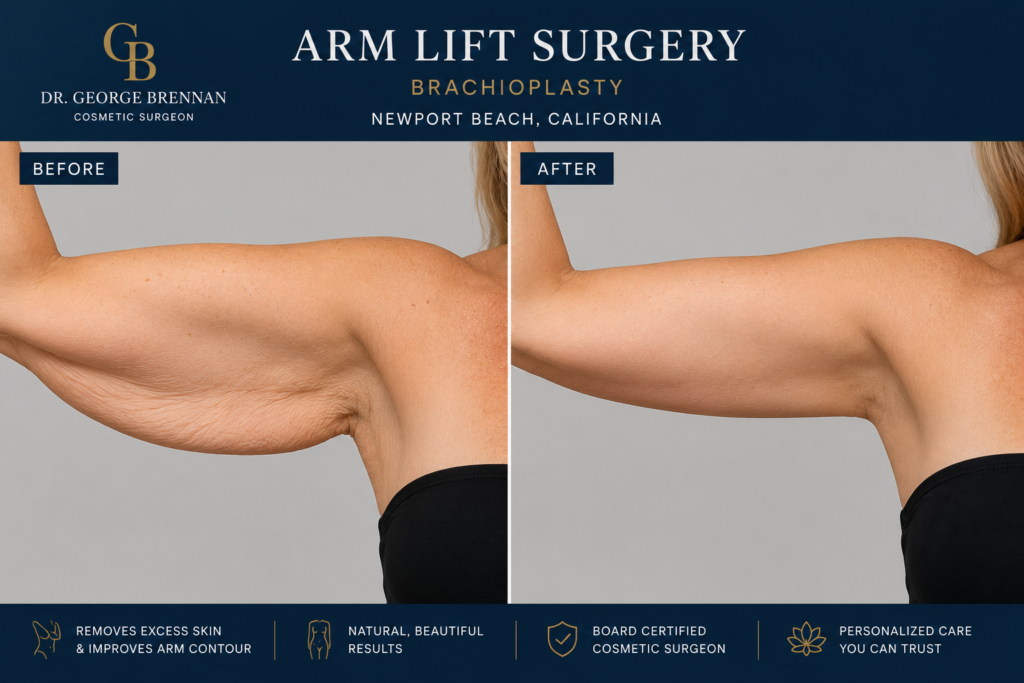
The upper arms can change significantly with age, weight loss, genetics, and reduced skin elasticity. Even when exercise improves muscle tone, it cannot always tighten skin that has stretched or lost its ability to contract. This can leave folds of loose tissue beneath the upper arms that affect clothing choices, movement, comfort, and body confidence.
An arm lift, medically known as brachioplasty, reshapes the area between the underarm and elbow by removing excess skin and, when appropriate, reducing localized fat. Patients researching arm lift surgery in Newport Beach often want to understand how the procedure differs from liposuction, where scars are placed, and what recovery involves.
Dr. George Brennan includes arm lift surgery within his focused approach to aging body procedures and cosmetic body contouring. Every treatment plan should reflect the patient’s skin quality, arm shape, health, weight stability, and expectations. The objective is not to create an artificial appearance. It is to achieve smoother, more proportionate upper arms while balancing the improvement against the necessary surgical scar.
What Is Brachioplasty?
Brachioplasty is a cosmetic surgical procedure designed to reshape the underside of the upper arm. The treated area commonly extends from the underarm toward the elbow, although incision length varies according to the amount and location of excess tissue.
During surgery, the cosmetic surgeon may:
- Remove loose or hanging skin
- Reduce selected areas of excess fat
- Reshape the underlying supportive tissue
- Improve the transition between the upper arm and underarm
- Create a firmer and smoother upper arm contour
- Address differences between the right and left arms
The American Society of Plastic Surgeons defines an arm lift as a procedure that reshapes the underside of the upper arm from the underarm region toward the elbow. Patients can review its general arm lift procedure overview before meeting with their surgeon.
A consultation for brachioplasty in Newport Beach should clarify whether skin, fat, tissue laxity, or a combination of concerns is creating the unwanted contour.
Why Does Loose Upper Arm Skin Develop?
Loose skin can develop when the tissue has been stretched beyond its ability to contract. Several factors may contribute.
Significant weight loss
Patients who lose a substantial amount of weight may be left with excess skin on the arms, abdomen, chest, thighs, or lower body. The amount of remaining skin depends on age, genetics, the amount of weight lost, and how long the tissue was stretched.
Arm contouring after weight loss may involve a full arm lift when hanging skin extends from the elbow toward the underarm. Patients with excess skin in several areas may also explore broader body-contouring procedures.
Aging
As skin loses elasticity, the upper arms may gradually become softer and less defined. Changes in collagen, tissue support, muscle mass, and fat distribution can contribute to this appearance.
For some patients, brachioplasty becomes part of a wider aging body surgery plan that may include a tummy tuck, thigh lift, breast lift, or lower body lift.
Genetics
Some people naturally develop loose upper arm tissue even without major weight changes. Skin elasticity, fat distribution, and arm proportions can all have a genetic component.
Weight fluctuations
Repeated weight gain and loss can stretch the skin and reduce its ability to return to a firmer position.
Sun exposure and lifestyle factors
Long-term sun exposure, nicotine use, and other factors may affect skin quality and healing. These considerations should be discussed before surgery.
Who May Be a Candidate for Arm Lift Surgery?
A patient may consider an arm lift when excess upper arm skin remains despite maintaining a stable weight and following a healthy lifestyle.
Potential candidates may have:
- Hanging skin beneath the upper arms
- Loose tissue following significant weight loss
- Reduced upper arm definition with age
- Discomfort caused by skin rubbing or folding
- Difficulty finding clothing that fits comfortably
- Concerns about raising or exposing the arms
- Localized fat combined with poor skin elasticity
- Realistic expectations about scars and recovery
Good candidates should generally be in suitable health, maintain a stable weight, and avoid nicotine. Patients should also understand that brachioplasty replaces loose skin with a permanent scar.
The position and length of that scar depend on the extent of loose upper arm skin removal required. For many patients, accepting the scar is the central consideration when deciding whether the improvement is worthwhile.
Arm Lift Versus Liposuction
Arm lift surgery and liposuction address different anatomical concerns.
Liposuction removes localized fat through small incisions. It may be appropriate when a patient has excess upper arm fat but reasonably firm skin that is likely to contract after fat removal.
Brachioplasty is generally more appropriate when loose skin is the main concern.
Liposuction may be considered when:
- The concern is primarily localized fat
- Skin elasticity remains relatively good
- There is little hanging skin
- The patient does not need substantial tissue removal
- The arm contour is expected to improve after fat reduction
Arm lift surgery may be considered when:
- Loose skin hangs from the upper arm
- Skin elasticity is poor
- Weight loss has left significant tissue redundancy
- Removing fat alone could make sagging more noticeable
- The patient accepts the need for a longer scar
Some patients benefit from both procedures. Liposuction may refine fat deposits while brachioplasty removes the remaining loose skin.
Patients researching liposuction in Newport Beach should ask whether their skin is likely to contract sufficiently after fat reduction alone.
Can Nonsurgical Skin Tightening Replace an Arm Lift?
Nonsurgical skin-tightening treatments are increasingly discussed by patients who want to avoid surgery or visible scars. These options may provide modest improvement for carefully selected individuals with mild skin laxity.
However, nonsurgical treatment generally cannot remove substantial folds of hanging skin.
A patient with early laxity and good skin quality may be a candidate for limited treatment. Someone with significant post-weight-loss tissue usually requires surgical removal to achieve a meaningful change.
The most appropriate recommendation depends on:
- The degree of skin looseness
- Skin thickness and elasticity
- Amount of localized fat
- History of weight loss
- Desired degree of improvement
- Willingness to accept a surgical scar
- Health and recovery considerations
An experienced and responsible cosmetic surgeon in Newport Beach should clearly explain whether a nonsurgical option is likely to meet the patient’s expectations.
What Are the Different Arm Lift Incision Options?
The incision pattern used for upper arm skin tightening surgery depends on where the loose tissue is located and how much correction is needed.
Limited-incision arm lift
A shorter incision may be placed within or near the underarm when loose skin is concentrated in the uppermost portion of the arm. This technique provides limited correction and is not suitable for tissue that extends toward the elbow.
Standard arm lift
A standard incision may extend from the underarm toward the elbow. It is commonly placed along the inner or lower portion of the arm so it is less visible when the arms rest naturally at the sides.
Extended arm lift
An extended incision may continue through the underarm and onto the side of the chest when loose tissue affects both the upper arm and lateral chest.
The best incision is not automatically the shortest one. It is the incision that provides adequate access to remove the necessary tissue while allowing safe closure and a balanced contour.
Patients should ask where the scar will be located, how long it may be, and how it is expected to mature.
How Does Arm Contouring After Weight Loss Differ?
Patients who have experienced major weight loss often have more extensive skin laxity than patients seeking treatment for age-related changes alone.
The loose skin may:
- Extend from the elbow to the underarm
- Continue onto the side of the chest
- Form multiple folds
- Contain areas of residual fat
- Differ significantly between the arms
- Affect movement, hygiene, or clothing comfort
In these situations, arm contouring may be planned as one stage of a broader post-weight-loss transformation.
The American Board of Cosmetic Surgery identifies arm lifts, thigh lifts, tummy tucks, breast lifts, and body lifts among the procedures commonly considered to remove excess skin and improve contours after substantial weight loss. Patients can review its skin removal after weight loss guide.
A staged approach may be recommended when several areas require treatment. This can help manage surgical time, healing demands, and recovery support.
When Is Body Lift Surgery Considered?
Body lift surgery in Orange County may be considered when excess skin affects several connected areas of the body, particularly after major weight loss.
Depending on the patient, a body-contouring plan may involve:
- Arm lift
- Tummy tuck
- Lower body lift
- Thigh lift
- Breast lift
- Liposuction
- Back or lateral chest contouring
Not all of these procedures should necessarily be performed together. Combining too many treatment areas can increase the physical demands of surgery and recovery.
Patients can explore body contouring in Newport Beach, California to learn how individual procedures may be organized into a personalized and carefully staged plan.
What Happens During an Arm Lift Consultation?
A thorough consultation should evaluate the entire upper arm rather than focusing only on one fold of skin.
Dr. Brennan or another qualified surgeon may assess:
- Amount and location of loose skin
- Upper arm fat distribution
- Skin elasticity
- Arm symmetry
- Underarm and lateral chest tissue
- Previous scars
- Weight history
- General health
- Medical conditions
- Medications and supplements
- Nicotine use
- Recovery support
- Personal concerns about scar placement
The surgeon may also take photographs and discuss whether liposuction, a limited lift, a standard brachioplasty, or a more extensive procedure is appropriate.
Patients should be honest about their expectations. A surgeon can improve the contour, but cannot guarantee perfectly symmetrical arms, invisible scars, or permanent resistance to future aging.
How Should You Prepare for Brachioplasty?
Preparation supports safer surgery and a more organized recovery.
Patients may be asked to:
- Complete laboratory testing or a medical evaluation
- Adjust certain medications
- Stop nicotine use
- Avoid aspirin, anti-inflammatory medications, or selected supplements
- Maintain a stable weight
- Arrange transportation
- Prepare a comfortable recovery area
- Choose loose, easy-to-wear clothing
- Arrange help with meals and household responsibilities
- Plan time away from work
Patients should not stop prescription medications unless instructed by the appropriate medical professional. Because arm movement may be restricted, simple tasks such as washing hair, reaching overhead, opening containers, dressing, and lifting objects may require help during early recovery.
What Is Arm Lift Recovery Like?
Arm lift recovery varies according to the incision length, amount of tissue removed, whether liposuction is included, and the patient’s healing response.
Early recovery may involve:
- Swelling
- Bruising
- Tightness
- Tenderness
- Temporary numbness
- Limited arm movement
- Incision sensitivity
- Mild differences between the arms
Dressings are usually placed over the incisions. The arms may be wrapped or supported with compression garments to help manage swelling. Temporary drains may be used when needed.
Patients should avoid lifting, pushing, pulling, or placing excessive tension on the incisions. Keeping the arms elevated as instructed may help manage swelling.
Many patients return to desk-based work within approximately one to two weeks, although this varies. People with physical jobs or duties requiring repetitive arm movement may need more time.
Strenuous upper-body exercise and heavy lifting should resume only after surgical clearance. The American Society of Plastic Surgeons provides additional arm lift recovery guidance.
What Are the Risks of Arm Lift Surgery?
Every surgical procedure carries potential risks.
Arm lift risks may include:
- Bleeding
- Infection
- Anesthesia complications
- Fluid accumulation
- Poor wound healing
- Noticeable or widened scars
- Changes in skin sensation
- Persistent pain
- Arm asymmetry
- Contour irregularities
- Injury to deeper structures
- Fat necrosis
- Blood clots
- Need for revision surgery
Scarring is not simply a possible risk of brachioplasty. It is an expected part of the procedure. The concern is how the scar heals, where it is placed, and whether it widens, thickens, darkens, or becomes uncomfortable.
Patients should discuss personal or family histories of raised or abnormal scars. They should also follow instructions for incision care, activity, compression garments, and sun protection.
What Creates Natural Arm Lift Results?
Natural arm lift results should improve the upper arm without making it appear overly tight or out of proportion with the shoulders, forearms, chest, and overall body.
Important factors include:
- Removing an appropriate amount of skin
- Preserving safe tissue circulation
- Avoiding excessive tension
- Managing localized fat conservatively
- Placing incisions thoughtfully
- Creating a smooth transition into the underarm
- Respecting natural differences between the arms
- Matching the treatment to the patient’s body proportions
The initial contour may be visible soon after surgery, but swelling can temporarily affect the shape. Scars also require time to mature.
Results can be long-lasting when the patient maintains a stable weight. Aging and changes in skin elasticity will continue, but the removed skin does not grow back.
How Visible Are Arm Lift Scars?
Scar visibility is one of the most important topics to discuss before brachioplasty.
A standard arm lift scar may extend from the underarm toward the elbow. It is usually placed along the inner or lower arm, but exact placement depends on the surgeon’s technique and the patient’s tissue pattern.
Scars may initially appear:
- Pink or red
- Firm
- Raised
- Uneven
- More noticeable than expected
They generally soften and fade over time, although they remain permanent. Scar maturation may take a year or longer.
Patients should follow instructions involving:
- Incision care
- Silicone products when recommended
- Sun protection
- Compression garments
- Activity restrictions
- Follow-up visits
- Monitoring for infection or delayed healing
The decision to proceed often comes down to whether the patient prefers the existing loose skin or a smoother arm contour with a visible scar.
Questions to Ask Before Arm Lift Surgery
Before scheduling arm lift surgery in Newport Beach, patients may want to ask:
- Is loose skin or excess fat causing most of my concern?
- Would liposuction alone improve my arms?
- Where will the incisions be placed?
- How long will the scars be?
- Will the procedure include liposuction?
- Should my lateral chest also be treated?
- What risks are most relevant to me?
- How much help will I need after surgery?
- When can I return to work and exercise?
- How should I care for the incisions?
- Can I review before-and-after photographs?
- Would staging my procedures be safer?
A high-quality consultation should provide clear information rather than pressure.
Frequently Asked Questions About Brachioplasty
Does an arm lift remove fat?
An arm lift primarily removes loose skin, but selected fat may also be reduced. Liposuction may be incorporated when localized fat contributes to the arm contour.
Can exercise tighten loose upper arm skin?
Exercise can strengthen the underlying muscles, but it cannot remove significant stretched skin. Patients with good elasticity and limited fat may see some improvement in shape through fitness, but hanging skin usually requires surgical removal.
Is arm lift surgery only for weight-loss patients?
No. Brachioplasty may also help patients with age-related skin laxity, hereditary tissue looseness, or upper arm changes caused by repeated weight fluctuations.
How long does arm lift recovery take?
Many patients resume light desk-based activities within one or two weeks. Heavy lifting, strenuous exercise, and repetitive arm movements generally require a longer restriction period.
Are arm lift scars permanent?
Yes. Scars usually fade and soften, but they do not disappear completely.
Can both arms be treated during the same operation?
Yes. Both arms are normally treated during the same surgery to improve balance and symmetry.
Choosing a Cosmetic Surgeon for Arm Lift Surgery
Brachioplasty requires careful tissue removal, scar placement, symmetry assessment, and management of the structures beneath the upper arm skin.
When selecting a surgeon, consider:
- Relevant body-contouring experience
- Professional credentials and certifications
- Before-and-after results
- Transparent discussion of scars
- Clear safety and recovery guidance
- Personalized recommendations
- Accredited surgical facilities
- Anesthesia planning
- Postoperative support
- Willingness to discuss less extensive alternatives
Dr. George Brennan has focused his practice on a defined group of cosmetic procedures, including aging body surgery, arm lift, thigh lift, lower body lift, tummy tuck, liposuction, breast surgery, and facial contouring.
Patients can learn more about Dr. George Brennan’s cosmetic surgery experience and his history of procedural innovation, physician education, and detail-focused care.
Refining the Upper Arms With a Personalized Plan
An arm lift can improve loose upper arm skin that does not respond to exercise, weight stability, or nonsurgical treatment. The procedure can be especially meaningful for patients after substantial weight loss or those experiencing age-related skin laxity.
The tradeoff is a permanent scar. A thoughtful consultation should clearly explain that balance while helping the patient understand expected improvement, risks, healing, and long-term results.
Some patients need a standard brachioplasty, while others may benefit from liposuction, a limited-incision approach, an extended arm lift, or a staged body-contouring plan.
Patients considering brachioplasty in Newport Beach can meet with Dr. George Brennan to discuss their upper arm anatomy, skin quality, scar placement, recovery, and realistic goals.
To begin planning a personalized approach, schedule an arm lift consultation with Dr. George Brennan.