
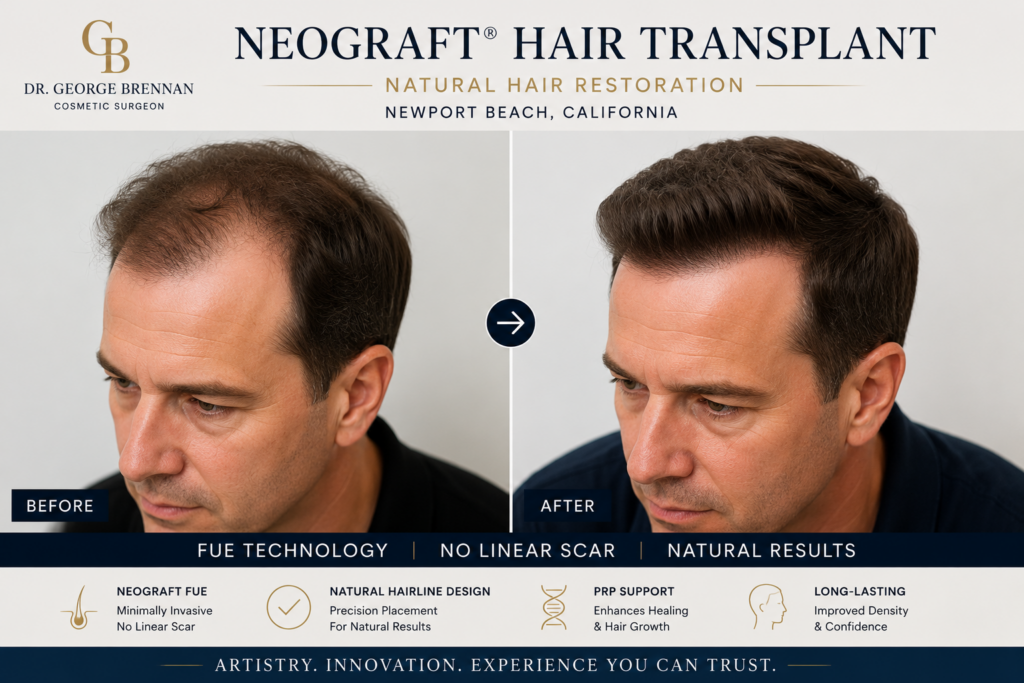
Hair thinning can affect confidence, self-image, and how a person feels in daily life. For many men and women, hair loss begins gradually with a receding hairline, widening part, thinning crown, or reduced density. Others notice changes after stress, aging, hormonal shifts, genetics, or medical factors.
For patients researching a NeoGraft hair transplant in Newport Beach, modern hair restoration offers a more refined way to approach hairline improvement and density restoration. NeoGraft is a minimally invasive hair transplant method that uses follicular unit extraction, commonly called FUE, to move healthy hair follicles from a donor area to thinning areas of the scalp.
Dr. George Brennan has been part of the evolution of hair restoration from its earlier stages. His contributions include designing original instrumentation for mini strip grafts, introducing the Juri-Flap to the United States, and designing scalp reduction techniques. Today, his Newport Beach practice offers NeoGraft hair restoration as a modern solution for patients seeking natural-looking hair restoration with careful planning and artistry.
What Is NeoGraft Hair Restoration?
NeoGraft is an advanced hair transplant technology that assists with follicular unit extraction. During FUE, individual follicular units are removed from the donor area, often the back or sides of the scalp, and placed into areas where hair is thinning.
A FUE hair transplant in Newport Beach may be considered for patients who want fuller density, hairline refinement, or improvement in areas affected by pattern hair loss.
NeoGraft may help address:
- Receding hairline
- Thinning crown
- Widening part
- Early to moderate hair loss
- Lower scalp density
- Hairline irregularity
- Selected areas of patchy thinning
- Hair loss in men and women
Unlike older strip harvesting techniques, FUE does not require removing a linear strip of scalp. This may reduce visible linear scarring and allow selected patients to wear shorter hairstyles after healing.
Patients can learn more about hair restoration services in Newport Beach and whether NeoGraft may be appropriate for their pattern of hair loss.
How Does a NeoGraft Hair Transplant Work?
A NeoGraft hair transplant in Newport Beach begins with a detailed consultation. The surgeon evaluates the scalp, hairline, donor density, hair texture, medical history, and goals.
The process generally includes:
- Donor area selection
Healthy hair follicles are usually taken from areas that are genetically more resistant to hair loss, often the back or sides of the scalp. - Follicle extraction
NeoGraft technology assists in removing individual follicular units with a small circular tool. - Graft preparation
The follicles are carefully handled and prepared for placement. - Recipient site planning
Tiny sites are created in the thinning area based on hair direction, density goals, and natural growth pattern. - Follicle placement
The grafts are placed into the planned areas to support a natural appearance as they grow.
The artistry of the procedure matters. Hair direction, angle, density, hairline shape, and long-term hair loss patterns must be considered. The goal is not simply to add hair. The goal is to create natural hairline restoration that fits the patient’s age, facial structure, and future hair loss risk.
Why Patients Choose NeoGraft Over Older Hair Transplant Methods
Many patients are interested in a minimally invasive hair transplant because they want a less noticeable donor-area scar and a more comfortable recovery than older methods may involve.
Potential benefits of NeoGraft may include:
- No linear strip incision
- Reduced visible donor-area scarring
- Natural-looking follicle placement
- Useful for hairline and density refinement
- Shorter hairstyle flexibility for many patients
- Custom planning for men and women
- Less invasive donor harvesting than strip surgery
Not every patient is an ideal candidate. Donor density, hair quality, scalp health, degree of hair loss, and expectations all influence whether NeoGraft is appropriate. A consultation at a hair restoration clinic in Newport Beach, California should include an honest discussion about what can and cannot be achieved.
Hair Transplant for Men and Women
Hair loss is often associated with men, but women also seek hair restoration. A hair transplant for men and women must be planned differently because hair loss patterns often vary.
Men commonly experience:
- Receding temples
- Thinning crown
- M-shaped hairline changes
- Progressive male pattern baldness
Women may experience:
- Widening part
- Diffuse thinning
- Reduced density across the top of the scalp
- Hairline thinning
- Hormonal or age-related changes
Women with diffuse thinning may require additional evaluation before surgery because the donor area must be strong enough to support transplanting. Some patients may need medical evaluation to rule out thyroid issues, anemia, hormonal changes, stress-related shedding, autoimmune concerns, or medication-related hair loss. For both men and women, the best results begin with accurate diagnosis.
What Creates Natural Hairline Restoration?
A natural hairline is not perfectly straight or overly dense at the front. Real hairlines have subtle irregularity, soft transitions, and age-appropriate placement.
Natural hairline restoration depends on:
- Hairline design
- Direction of follicle placement
- Graft spacing
- Donor hair quality
- Long-term hair loss planning
- Scalp health
- Face shape
- Age and gender
- Hair texture and curl pattern
- Surgeon judgment
Placing a hairline too low can look unnatural and may create problems if future hair loss progresses behind it. A conservative, well-designed hairline often provides a better long-term result. Dr. Brennan’s long history in cosmetic surgery and hair restoration supports the detailed planning needed for natural balance.
Who May Be a Candidate for NeoGraft?
A patient may be a candidate for NeoGraft hair restoration if they have stable hair loss, sufficient donor hair, realistic goals, and good general health.
Potential candidates may have:
- Male or female pattern hair loss
- A thinning hairline
- Thinning at the crown
- Localized density loss
- Adequate donor hair
- Healthy scalp tissue
- Realistic expectations about density
- Interest in a minimally invasive option
Patients may not be ideal candidates if they have active scalp disease, poor donor density, unstable shedding, unrealistic expectations, or medical causes of hair loss that have not been evaluated. A hair transplant in California should not be approached as a one-size-fits-all treatment. Each plan should be customized based on anatomy, hair pattern, and future hair loss risk.
What Happens During a NeoGraft Consultation?
A thorough consultation helps determine whether hair transplantation is the right option.
The consultation may include:
- Review of hair loss history
- Family pattern assessment
- Scalp and donor area evaluation
- Hairline planning
- Discussion of previous treatments
- Review of medical history
- Medication and supplement review
- Discussion of PRP hair restoration
- Explanation of recovery
- Realistic density planning
- Review of cost factors
- Before-and-after photo discussion
Patients should explain when hair loss began, how quickly it progressed, and what treatments they have already tried. A strong consultation should also address whether the patient may benefit from combining hair transplant surgery with supportive treatments.
PRP Hair Restoration and Supportive Treatment
PRP hair restoration uses platelet-rich plasma from the patient’s own blood. PRP contains growth factors that may support scalp health and hair follicle activity in selected patients.
PRP is not the same as a hair transplant. It does not move follicles from one area to another. Instead, it may be used as a supportive treatment for certain types of thinning or as an adjunct to hair restoration planning.
PRP may be considered for:
- Early thinning
- Support after hair transplant
- Maintenance planning
- Patients not ready for transplant
- Improving scalp environment in selected cases
Some patients may benefit from PRP alone, while others may combine it with NeoGraft. The right plan depends on the patient’s hair loss pattern and goals.
NeoGraft Versus Traditional Hair Transplant
Traditional strip hair transplant surgery removes a strip of scalp from the donor area. The strip is then divided into follicular units and transplanted into thinning areas.
NeoGraft uses FUE technology to extract individual follicular units without a long linear incision.
Key differences include:
- NeoGraft uses individual follicle extraction
- Traditional strip surgery creates a linear donor scar
- FUE may allow more hairstyle flexibility
- Strip surgery may still be considered in selected cases
- Both methods require artistic placement
- Both require healthy donor hair
- Both depend on long-term planning
The best method depends on patient anatomy, goals, donor supply, previous procedures, and surgeon recommendation. Patients considering a hair transplant in Newport Beach should ask which method best fits their needs.
What Is Recovery Like After NeoGraft?
Recovery after a NeoGraft hair transplant in Newport Beach varies depending on the number of grafts, scalp sensitivity, and individual healing.
Early recovery may include:
- Mild swelling
- Tenderness
- Small scabs around grafts
- Temporary redness
- Itching
- Donor-area sensitivity
- Temporary shedding of transplanted hairs
Patients are typically given detailed instructions for washing, sleeping, activity, sun exposure, and protecting the grafts.
Transplanted hairs often shed in the weeks after surgery. This can be normal. New growth usually begins gradually over several months, with continued improvement over time. Hair restoration requires patience. Final results are not immediate because follicles need time to settle, cycle, and grow.
How Long Do NeoGraft Results Take?
Hair growth after transplant occurs in phases.
A general timeline may include:
- First few days: healing of donor and recipient areas begins
- First few weeks: small scabs resolve and transplanted hairs may shed
- Three to four months: early new growth may begin
- Six months: visible improvement may become more noticeable
- Nine to twelve months: density and texture continue developing
- Twelve months or longer: final results are usually clearer
Some patients continue to see improvement beyond one year, especially in areas where hair grows more slowly. Because non-transplanted hair may continue to thin over time, maintenance planning is important.
What Results Can Patients Expect?
NeoGraft can improve density and hairline appearance, but it does not create unlimited hair. The result depends on donor supply, hair caliber, scalp contrast, number of grafts, placement strategy, and future hair loss.
Patients with thick donor hair may achieve more visible density than those with fine hair. Dark hair against light scalp may require different planning than lighter hair with less contrast.
A realistic plan focuses on:
- Natural placement
- Long-term hairline design
- Balanced density
- Donor preservation
- Future hair loss management
- Patient education
The goal is natural-looking improvement that ages well.
How to Choose a Hair Restoration Clinic in Newport Beach, CA
Choosing a hair restoration clinic in Newport Beach, California requires more than comparing technology. The device matters, but the planning, experience, and aesthetic judgment behind the procedure matter just as much.
Look for a provider who offers:
- Careful donor-area evaluation
- Natural hairline design
- Realistic density expectations
- Experience with men and women
- Clear recovery instructions
- Long-term maintenance planning
- Before-and-after examples
- Honest discussion of limitations
- Medical evaluation when needed
- Personalized consultation
Dr. George Brennan has been involved in hair restoration innovation for many years and introduced the latest state-of-the-art NeoGraft technology to offer patients a modern option for hair loss concerns.
Patients can learn more about Dr. George Brennan’s surgical innovations and his broader contributions to cosmetic surgery and hair restoration.
Frequently Asked Questions About NeoGraft Hair Restoration
Is NeoGraft a type of FUE hair transplant?
Yes. NeoGraft assists with follicular unit extraction, a method that removes individual follicular units from the donor area and places them into thinning areas.
Is NeoGraft only for men?
No. NeoGraft may be used for men and women when the patient has appropriate hair loss patterns and sufficient donor hair.
Does NeoGraft leave a scar?
NeoGraft does not create a long linear strip scar. However, all surgery can create small marks. FUE typically leaves tiny dot-like donor sites that often become less noticeable after healing.
When will I see results?
New growth usually begins gradually over several months. Many patients see noticeable improvement around six to twelve months, with continued refinement over time.
Can PRP be combined with NeoGraft?
Yes. PRP hair restoration may be used as a supportive treatment in selected patients, either before or after hair transplant planning.
Will I need more than one hair transplant?
Some patients may benefit from additional treatment if hair loss progresses or if greater density is desired. Long-term planning is important.
A Modern Approach to Hair Restoration in Newport Beach
Hair restoration is both technical and artistic. A successful plan must consider donor supply, scalp health, hairline design, density, future loss, and natural facial balance.
NeoGraft offers a modern option for patients seeking a minimally invasive hair transplant without a traditional linear strip incision. For men and women with appropriate candidacy, the procedure may support natural hairline restoration and improved density.
Dr. George Brennan’s long-standing contributions to hair restoration, including instrumentation design and surgical innovation, provide a strong foundation for patients exploring NeoGraft today.
Patients considering a NeoGraft hair transplant in Newport Beach can schedule a private consultation to discuss hair loss patterns, donor area quality, PRP hair restoration, recovery, expected growth, and realistic goals.
To begin, schedule a hair restoration consultation with Dr. George Brennan.