
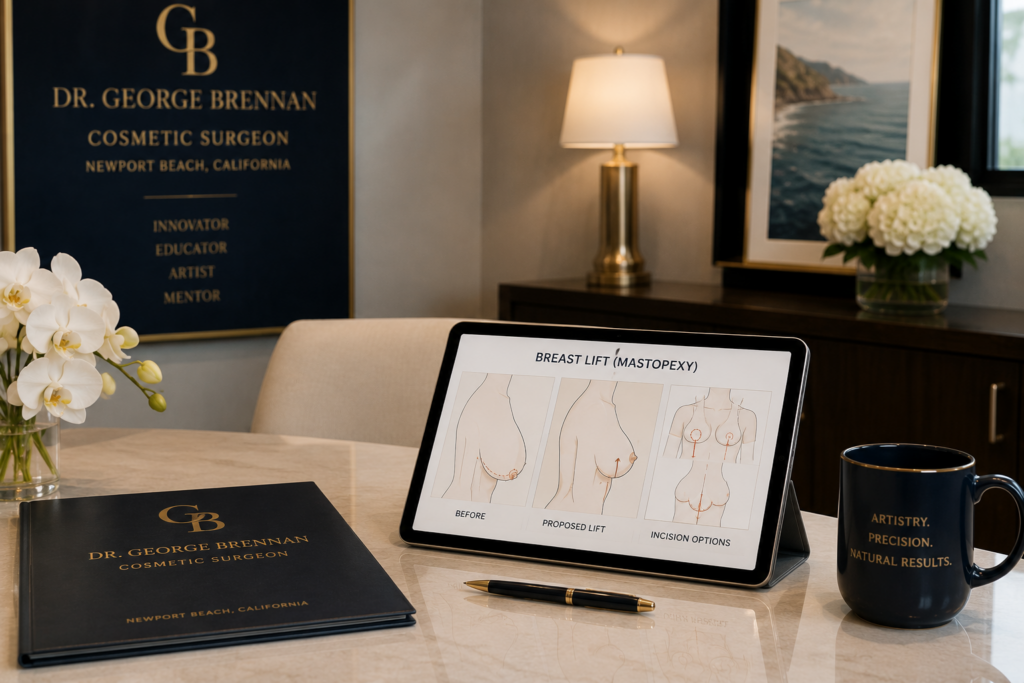
Changes in breast shape can occur gradually or after major life events. Pregnancy, breastfeeding, weight fluctuations, aging, genetics, and changes in skin elasticity can cause the breasts to sit lower on the chest, lose upper fullness, or develop stretched tissue around the nipple and areola.
A breast lift, medically known as mastopexy, is designed to reshape and elevate the breast by removing excess skin and repositioning existing tissue. For patients researching a breast lift in Newport Beach, the procedure may provide a more balanced silhouette while preserving a natural relationship between the breasts, chest, shoulders, and overall body proportions.
A breast lift does not have one standard result. Each procedure must be planned around the patient’s anatomy, degree of sagging, breast volume, skin quality, nipple position, lifestyle, and personal goals.
Dr. George Brennan has extensive experience with cosmetic breast surgery and approaches breast reshaping with attention to proportion, symmetry, incision planning, and natural-looking outcomes. Patients considering mastopexy in Newport Beach can benefit from understanding what the procedure can accomplish, when an implant may be helpful, and what to expect during recovery.
What Is a Breast Lift?
A breast lift is a cosmetic surgical procedure that raises and reshapes breasts affected by sagging, also known as breast ptosis.
During the procedure, excess skin is removed, the breast tissue is reshaped, and the nipple and areola are repositioned to a more youthful location. When necessary, an enlarged areola may also be reduced to better match the new breast shape.
A breast lift may improve:
- Low or downward-pointing nipples
- Stretched breast skin
- Loss of breast firmness
- Uneven breast position
- A flattened or elongated breast shape
- Enlarged areolas
- Breast sagging after pregnancy or weight loss
- Loss of definition between the breast and upper abdomen
The procedure focuses primarily on position and shape. It does not automatically increase breast volume, although reshaping existing tissue can sometimes create a fuller or more projected appearance.
Patients looking into breast surgery in Newport Beach should begin by identifying whether their main concern is sagging, volume loss, breast size, asymmetry, or a combination of issues.
Why Do Breasts Begin to Sag?
Breast sagging develops when the skin and internal support structures can no longer maintain the breast in its previous position.
Common contributing factors include:
Pregnancy and breastfeeding
Pregnancy can enlarge the breasts and stretch the skin. After pregnancy or breastfeeding, breast volume may decrease while the skin remains stretched. This can lead to a lower breast position and reduced upper-pole fullness.
A breast lift after pregnancy may help reposition the breast and restore a more balanced contour after childbearing is complete.
Aging
Skin gradually loses elasticity with age. Breast tissue may also become softer or less firm, causing the breasts to settle lower on the chest.
Weight changes
Significant weight gain and loss can stretch breast skin and alter the balance between skin and tissue. Patients who have lost a substantial amount of weight may experience more pronounced sagging.
Genetics
Some patients naturally have softer skin, heavier breast tissue, or less internal support. These characteristics can affect when and how breast sagging develops.
Gravity
Gravity continuously affects the breasts, especially when breast tissue is heavy or the skin is less elastic.
Effective breast sagging correction requires a treatment plan based on the cause and degree of the change, rather than a one-size-fits-all approach.
What Is Mastopexy?
Mastopexy is the medical term for breast lift surgery. The procedure may include several coordinated steps:
- Removing excess breast skin
- Reshaping the remaining breast tissue
- Elevating the nipple and areola
- Reducing the areola when appropriate
- Improving differences between the breasts
- Recreating a more defined breast contour
- Supporting the breast in a higher position
The exact technique depends on the amount of excess skin and how far the nipple has descended.
A patient with mild sagging may require a shorter incision pattern. Someone with more advanced sagging, stretched skin, or a lower nipple position may need a more extensive approach.
The goal of mastopexy in Newport Beach should not be to force every breast into the same shape. It should be to create proportionate, natural-looking improvement based on the patient’s body.
Who May Be a Candidate for Breast Lift Surgery?
A patient may consider a breast lift when breast shape has changed in a way that affects comfort, clothing fit, body confidence, or personal satisfaction.
Potential candidates may have:
- Breasts that sit lower than desired
- Nipples positioned below the breast crease
- Nipples that point downward
- Loose or stretched skin
- Uneven breast height
- Loss of upper breast fullness
- Breasts that appear flattened or elongated
- Enlarged or stretched areolas
- Changes following pregnancy, breastfeeding, aging, or weight loss
Good candidates should also be in suitable health, have stable weight, avoid nicotine, and understand the expected scars and recovery process.
Patients planning future pregnancies may choose to delay surgery because pregnancy can stretch the breast skin again. However, this decision is personal and should be discussed during consultation.
What Are the Main Types of Breast Lifts?
The phrase types of breast lifts generally refers to the incision pattern used during surgery. The amount of sagging, nipple position, breast size, and skin quality help determine which pattern may be appropriate.
Crescent lift
A small crescent of skin is removed above the areola. This approach is used selectively for very mild nipple elevation and provides limited correction.
Periareolar lift
The incision is placed around the areola. This may be suitable for mild sagging or areola reduction. However, it may not provide enough correction for more advanced breast descent.
Vertical breast lift
This pattern includes an incision around the areola and a vertical incision extending to the breast crease. It is sometimes called a lollipop lift. It can provide meaningful reshaping for moderate sagging.
Anchor breast lift
This approach includes incisions around the areola, vertically to the breast crease, and along the crease beneath the breast. It may be recommended for significant sagging, excess skin, or major reshaping.
A shorter scar is not automatically better if it cannot provide adequate correction. The surgeon must balance incision length with the degree of lift, breast shape, tissue support, and long-term stability.
Breast Lift Versus Breast Augmentation
A breast lift and breast augmentation solve different concerns. A breast lift raises and reshapes existing breast tissue. Breast augmentation adds volume using implants or, in selected cases, fat transfer.
A breast lift may be more appropriate when the primary concern is:
- Sagging
- Low nipple position
- Stretched skin
- Elongated breast shape
- Uneven breast position
Breast augmentation may be considered when the primary concern is:
- Small breast volume
- Loss of fullness
- Limited upper-pole volume
- Desire for a larger cup size
- Breast asymmetry related to volume
Some patients need both procedures to achieve their goals.
When Is Breast Augmentation With Lift Recommended?
A breast augmentation with lift combines mastopexy with breast implants. This approach may be appropriate when a patient has both sagging and meaningful volume loss.
The lift repositions the breast and nipple, while the implant adds volume and may improve upper-breast fullness.
Patients who may benefit include those with:
- Deflated breasts after pregnancy
- Significant loss of upper fullness
- Sagging combined with naturally small breast volume
- A desire for both elevation and increased size
- Asymmetry involving position and volume
A combined procedure requires careful planning because lifting and enlarging the breast place different forces on the skin and tissues. The implant size should support the desired result without creating excessive weight or tension. Patients can learn more about breast augmentation in Newport Beach and how augmentation may be combined with a lift.
Can a Breast Lift Reduce Breast Size?
A standard breast lift removes excess skin but does not remove a large amount of breast tissue. Some patients may perceive a modest decrease in cup size because the breast becomes firmer and more compact.
Patients who want meaningful size reduction may need a breast reduction rather than mastopexy alone. Breast reduction removes excess breast tissue, fat, and skin while lifting the breast.
During consultation, patients should clearly explain whether they want to:
- Maintain their current volume
- Increase breast size
- Reduce breast size
- Improve shape without changing volume
- Restore fullness lost after pregnancy or weight changes
This distinction helps the surgeon recommend the correct form of breast reshaping surgery.
What Creates Natural Breast Lift Results?
Natural breast lift results depend on more than raising the nipple. The surgeon must consider how the entire breast relates to the chest wall and body.
Important factors include:
- Appropriate nipple height
- Balanced areola size
- Natural breast projection
- Smooth lower breast contour
- Symmetry between the breasts
- Proportion with the shoulders, waist, and hips
- Stable internal tissue support
- Controlled tension on the incisions
- Realistic implant sizing when augmentation is included
A breast that is lifted too aggressively may appear unnatural or place excessive stress on the skin. A conservative plan may age more naturally and provide a better balance between enhancement and long-term tissue support. Dr. George Brennan approaches breast lifting with detailed attention to anatomy, proportion, and each patient’s individual goals.
Breast Lift and Enhancement Without Excessive Volume
The term breast lift and enhancement does not always mean adding a large implant. Enhancement may involve improving shape, restoring nipple position, refining asymmetry, and creating a firmer contour.
Some patients prefer to keep their natural breast size while improving position. Others want a small implant to restore upper fullness without creating an obviously augmented appearance.
The treatment plan may include:
- Mastopexy alone
- Mastopexy with a small implant
- Mastopexy with a moderate implant
- Breast reduction with lift
- Implant exchange with lift
- Implant removal with lift
- Fat transfer in selected cases
The best plan is the one that matches the patient’s anatomy, tissue quality, lifestyle, and desired degree of change.
What Happens During a Breast Lift Consultation?
A thoughtful consultation should evaluate breast anatomy, health, and goals.
The surgeon may assess:
- Breast size and shape
- Nipple and areola position
- Skin elasticity
- Degree of sagging
- Breast asymmetry
- Chest-wall shape
- Existing implants
- Previous breast procedures
- Medical history
- Future pregnancy plans
- Desired breast volume
- Personal preferences regarding scars
Patients should ask to see before-and-after photographs of individuals with similar anatomy and concerns. A consultation with a cosmetic surgeon in Newport Beach should also include an honest discussion of risks, incision options, recovery, scar placement, and realistic results.
What Are the Risks of Breast Lift Surgery?
All surgical procedures carry risk. Potential breast lift risks may include:
- Bleeding
- Infection
- Anesthesia complications
- Scarring
- Delayed healing
- Changes in nipple or breast sensation
- Breast asymmetry
- Changes in nipple position
- Fluid accumulation
- Poor incision healing
- Partial or complete loss of nipple or areola tissue
- Difficulty breastfeeding
- Need for revision surgery
Risk varies based on health, nicotine use, breast size, tissue quality, surgical technique, and whether implants are used. Patients should provide a complete medical history and follow all preoperative and postoperative instructions.
What Is Breast Lift Recovery Like?
Recovery varies according to the surgical technique, whether implants are added, and the patient’s healing response.
During early recovery, patients may experience:
- Swelling
- Bruising
- Tightness
- Tenderness
- Temporary changes in sensation
- Limited arm movement
- Mild differences between the breasts
A surgical support bra may be recommended. Patients should avoid underwire bras until approved by the surgeon.
Many patients return to desk-based work within one or two weeks, although recovery differs. Heavy lifting, upper-body exercise, and strenuous activity usually require a longer pause.
Patients should carefully follow instructions about:
- Incision care
- Support garments
- Sleeping position
- Medication
- Showering
- Driving
- Exercise
- Follow-up appointments
- Warning signs
Scars often appear firm or pink at first and gradually soften and fade. They do not disappear completely.
How Long Do Breast Lift Results Last?
A breast lift can provide long-term improvement, but it cannot stop aging or gravity.
Results may be influenced by:
- Skin elasticity
- Breast weight
- Implant size
- Pregnancy
- Weight changes
- Genetics
- Sun exposure
- Nicotine use
- Support garment habits
Maintaining a stable weight and wearing supportive bras during exercise may help preserve the result. Patients with heavier breasts may experience more gradual settling than those with lighter breast tissue. Large implants can also place additional stress on the skin over time.
Breast Lift After Pregnancy
A breast lift after pregnancy can help address stretched skin, reduced fullness, and a lower nipple position. Many patients include mastopexy as part of a broader post-pregnancy treatment plan.
Some combine a breast lift with:
- Breast augmentation
- Breast reduction
- Tummy tuck
- Liposuction
- Body contouring
When multiple areas are treated together, the plan is sometimes referred to as a mommy makeover. However, every combination must be evaluated for safety, recovery demands, and overall surgical time.
Patients should ideally complete breastfeeding and allow the breasts to stabilize before surgery. Weight should also be relatively stable.
Frequently Asked Questions About Breast Lift Surgery
Does a breast lift make the breasts larger?
A breast lift reshapes and elevates existing tissue but does not significantly increase volume. An implant may be added when greater fullness or size is desired.
Can a breast lift correct uneven breasts?
Mastopexy can improve differences in nipple height, breast position, skin excess, and shape. Perfect symmetry cannot be guaranteed because natural anatomical differences remain.
Will I lose nipple sensation?
Temporary changes in sensation are common. Permanent changes are possible but less common. Individual risk depends on anatomy and surgical technique.
Can I breastfeed after a breast lift?
Some patients can breastfeed after mastopexy, but surgery may affect milk production or delivery. Patients planning future pregnancies should discuss this concern before surgery.
Will a breast lift remove stretch marks?
Stretch marks located on removed skin may be eliminated, but those remaining on the breast will still be present. Their position may change after reshaping.
Do I need an implant with my breast lift?
Not necessarily. An implant is only needed when the patient wants additional volume or upper fullness that cannot be created with existing tissue alone.
Choosing a Breast Lift Surgeon in Newport Beach
Breast lift surgery requires a detailed understanding of breast anatomy, scar placement, tissue support, nipple circulation, symmetry, and long-term shape.
When selecting a surgeon, consider:
- Relevant cosmetic breast surgery experience
- Professional credentials and certifications
- Natural-looking before-and-after results
- Clear explanations of incision options
- Honest discussions about risks and scars
- Personalized recommendations
- Appropriate surgical facility standards
- Reliable postoperative support
- Willingness to discuss alternatives
Dr. George Brennan who is a board certified surgeon and has extensive experience in breast surgery and has contributed innovations to cosmetic procedures throughout his career. His approach to breast surgery in Newport Beach emphasizes detailed planning, patient education, and natural aesthetic balance.
Patients can learn more about Dr. George Brennan’s experience and credentials before scheduling a consultation.
Restoring Shape With a Personalized Breast Lift
A breast lift can help restore a firmer, more elevated shape after pregnancy, weight loss, aging, or changes in skin elasticity. It may also improve nipple position, breast symmetry, clothing fit, and confidence.
The best results begin with an honest discussion about breast volume, desired shape, incision placement, recovery, and long-term expectations. Some patients benefit from mastopexy alone, while others may achieve their goals through a breast augmentation with lift, reduction with lift, or another personalized approach.
Patients considering a breast lift in Newport Beach can meet with Dr. George Brennan to discuss their anatomy, concerns, available options, and realistic goals.
To learn more, schedule a private breast surgery consultation with Dr. George Brennan.