
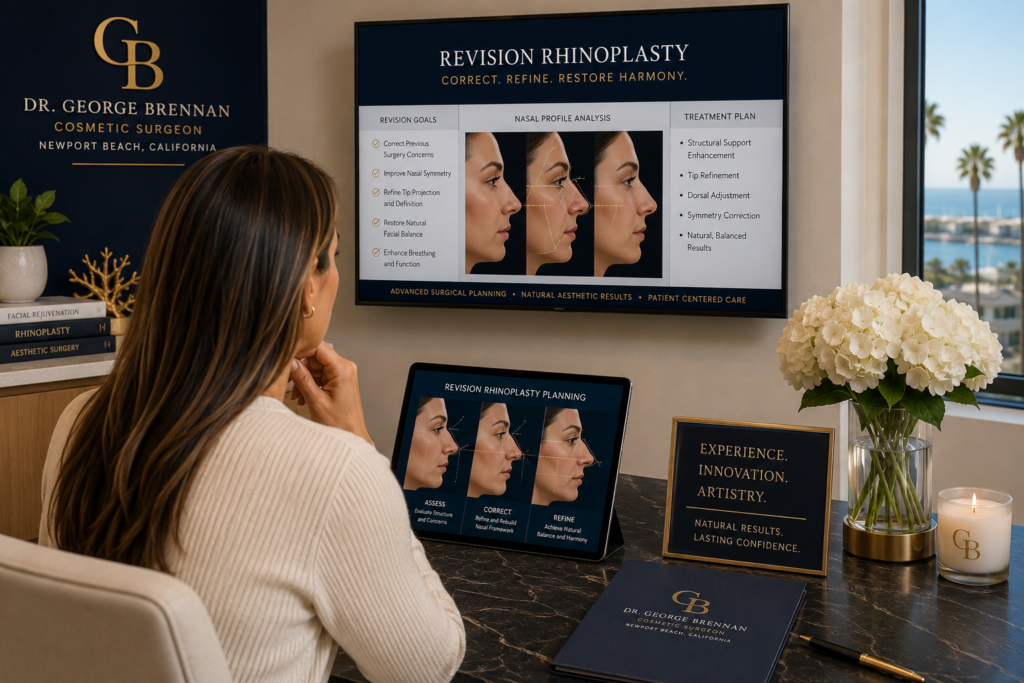
Rhinoplasty can improve the shape, proportion, and function of the nose, but healing is complex and results are not always predictable. Some patients remain concerned about the appearance of their nose after surgery, while others develop breathing difficulties, structural weakness, asymmetry, or changes that become more noticeable over time.
When a patient considers another operation, the procedure is generally called revision rhinoplasty, secondary rhinoplasty, or corrective nose surgery. Unlike a first-time rhinoplasty, revision surgery must account for altered anatomy, internal scar tissue, changes to cartilage, and the effects of the previous operation.
Patients researching revision rhinoplasty in Newport Beach should understand that a second nose surgery requires careful analysis, realistic expectations, and a surgeon experienced in both nasal structure and facial balance. The goal is not always to achieve perfection. It is to identify what can be safely improved while protecting breathing, support, proportion, and long-term stability.
Dr. George Brennan has extensive experience in cosmetic nasal surgery and developed the Closed Open Rhinoplasty technique as part of his broader contributions to cosmetic surgery. His approach emphasizes careful planning, discreet treatment, balanced refinement, and results that complement the patient’s overall facial features.
What Is Revision Rhinoplasty?
Revision rhinoplasty is surgery performed after a previous rhinoplasty to address unresolved, recurring, or newly developed concerns. It may involve a limited adjustment to one area or a more complex reconstruction of the nasal framework.
Patients may consider a revision nose surgery for cosmetic concerns, functional problems, or a combination of both.
Common reasons include:
- Persistent nasal asymmetry
- A crooked or uneven nasal bridge
- An overly reduced bridge
- A visible bump that remains after surgery
- An irregular or pinched nasal tip
- Nostril asymmetry
- A nose that appears too short or too long
- Internal or external nasal valve collapse
- Difficulty breathing through the nose
- Excessive scar tissue
- Cartilage weakness
- A result that does not fit the patient’s facial proportions
- Changes that develop as the nose heals
A qualified surgeon must determine whether the concern is caused by swelling, scar tissue, cartilage position, bone structure, skin thickness, or loss of nasal support. This evaluation is essential because each cause requires a different treatment strategy.
Why Do Some Patients Seek a Second Nose Surgery?
There are many reasons a patient may be dissatisfied after rhinoplasty. In some cases, the original result may have been technically acceptable but no longer aligns with the patient’s goals. In others, healing patterns, trauma, scar formation, or structural changes may affect the outcome.
The nose is made of bone, cartilage, soft tissue, skin, and internal support structures. Even small changes can influence both appearance and airflow.
Patients may seek secondary rhinoplasty in Newport Beach because they notice:
Nasal asymmetry
No human face is perfectly symmetrical, and some degree of asymmetry may remain after surgery. However, visible deviation, uneven nostrils, or a noticeably crooked tip may lead a patient to explore nasal asymmetry correction.
Breathing problems
A previous operation may weaken internal support or narrow the nasal airway. Functional problems can also remain if they were not fully addressed during the original procedure.
Overcorrection
Removing too much bone or cartilage can create a scooped bridge, pinched tip, shortened nose, or weakened nasal structure. Correcting overreduction may require cartilage grafting or structural reconstruction.
Undercorrection
A bridge bump, wide tip, nasal deviation, or nostril concern may remain after the first operation. In these cases, a focused revision may be possible if the underlying support remains stable.
Scar tissue
Internal scar tissue can affect nasal shape, tip definition, airflow, and movement. Scar tissue may also make revision surgery less predictable than a primary procedure.
Changing expectations
A patient’s goals may evolve with time. However, a responsible surgeon should help the patient distinguish between a correctable anatomical concern and an expectation that surgery cannot safely meet.
How Is Revision Rhinoplasty Different From Primary Rhinoplasty?
Primary rhinoplasty is performed on a nose that has not previously undergone surgery. Revision rhinoplasty involves tissues that have already been altered. This difference can make a second procedure more technically demanding.
A rhinoplasty surgeon in California performing revision surgery may encounter:
- Reduced or missing cartilage
- Dense internal scar tissue
- Altered blood supply
- Weakened structural support
- Changes in skin thickness
- Previous grafts or implants
- Distorted nasal anatomy
- Uncertainty about what was done during the first surgery
The surgeon may need to rebuild support rather than simply reshape the nose. Cartilage may be taken from the nasal septum when sufficient material remains. In more complex cases, cartilage from the ear or rib may be considered.
Revision surgery may also take longer than a first-time procedure because scarred tissues must be handled carefully. The surgical plan should be based on what is realistically achievable without placing the nose at unnecessary risk.
When Should a Patient Consider Revision Rhinoplasty?
Patients are often advised to wait until the nose has healed sufficiently before deciding whether another surgery is necessary. Swelling after rhinoplasty can last for many months, especially around the tip.
In many cases, a surgeon may recommend waiting approximately one year after the original operation before performing a major revision. Some patients may require more time depending on skin thickness, scar tissue, the extent of the first surgery, and the nature of the concern.
There are exceptions. A significant breathing problem, infection, trauma, or structural issue may require earlier assessment. However, evaluation does not always mean immediate surgery.
Waiting allows:
- Swelling to improve
- Scar tissue to mature
- Nasal tissues to soften
- The final shape to become clearer
- The blood supply to recover
- The surgeon to identify which concerns are permanent
Patients should avoid rushing into a second procedure based only on early swelling or temporary asymmetry.
What Does a Revision Rhinoplasty Consultation Include?
A thorough consultation should examine both appearance and function.
The surgeon may evaluate:
- The nasal bridge
- Nasal tip shape and support
- Nostril size and symmetry
- Nasal length and projection
- Internal breathing passages
- Septal position
- Skin thickness
- Scar tissue
- Facial proportions
- Previous incisions
- Available cartilage
- The relationship between the nose, chin, lips, and cheeks
Patients should bring previous operative reports, photographs, and medical records when available. Knowing what techniques, grafts, or implants were used can help the surgeon plan more accurately.
During the consultation, the patient should explain what they dislike about the current result and what they hope to change. Clear communication helps the surgeon determine whether the goal is safe, realistic, and compatible with the patient’s anatomy.
Understanding Nasal Asymmetry Correction
A frequent concern in corrective nose surgery is asymmetry. The nose may appear crooked from the front, uneven at the tip, or different from one side to the other.
Nasal asymmetry can come from:
- Uneven nasal bones
- A deviated septum
- Unequal tip cartilage
- Scar tissue
- Previous cartilage removal
- Uneven healing
- Facial asymmetry outside the nose
This last factor is especially important. The nose sits at the center of the face, but the eyes, cheeks, jaw, and chin may not be perfectly symmetrical. A nose can appear off-center even when its internal structure is relatively straight.
A careful surgeon evaluates the entire face rather than treating the nose in isolation. The objective is improvement and balance, not mathematically perfect symmetry.
What Is Dr. Brennan’s Closed Open Rhinoplasty?
Dr. George Brennan developed the Closed Open Rhinoplasty technique as one of his surgical innovations. The approach was designed to provide surgical access and refinement without the visible external incision traditionally associated with an open rhinoplasty approach.
The technique reflects Dr. Brennan’s focus on discreet surgery, structural planning, and natural facial proportions.
In revision cases, the exact surgical approach depends on what must be corrected. Some patients require limited internal refinement. Others need more extensive structural reconstruction.
A branded technique should not be selected only because of its name. The surgeon must determine whether it provides the access, visibility, and control required for the patient’s specific anatomy.
What Are Natural Rhinoplasty Results?
Natural rhinoplasty results should fit the patient’s face rather than calling attention to the nose as an isolated feature.
A natural result may involve:
- A smoother bridge
- Better tip definition
- Improved nasal alignment
- More balanced nostrils
- Appropriate projection
- Preserved ethnic and personal identity
- Improved breathing when functional concerns are present
- Better harmony between the nose, chin, cheeks, and lips
The goal is not to create the same nose for every patient. Facial structure, skin thickness, age, sex, heritage, and personal preferences should all influence the surgical plan.
Dr. Brennan’s experience with rhinoplasty and facial contouring supports a whole-face approach. In selected patients, the appearance of the nose may also be affected by the chin or jawline. A recessed chin, for example, can make the nose appear more prominent even when the nose itself is proportionate.
What Should Patients Look for in a Revision Rhinoplasty Surgeon?
Revision nasal surgery requires more than general cosmetic surgery experience. Patients should look for a surgeon with a detailed understanding of nasal anatomy, breathing function, structural support, facial proportion, and scarred tissue.
When comparing options for rhinoplasty in Newport Beach, patients should consider:
- Experience with primary and revision rhinoplasty
- Training and professional credentials
- Knowledge of nasal function
- Ability to perform structural reconstruction
- A consistent record of natural-looking outcomes
- Transparent discussion of risks and limitations
- Careful evaluation of facial proportions
- Clear postoperative instructions
- Access to appropriate follow-up care
- Willingness to recommend no surgery when revision is not advisable
Patients searching for a rhinoplasty surgeon in the USA may encounter dramatic marketing claims. Before-and-after photos can be helpful, but they should not replace a personal consultation. Every revision case is different, and photographs cannot show breathing quality, internal structure, or the full healing process.
Reviewing Newport Beach Rhinoplasty Before and After Photos
Patients often search for Newport Beach rhinoplasty before and after images when researching surgeons. These galleries can help show a surgeon’s aesthetic style, but they should be reviewed thoughtfully.
Look for:
- Multiple viewing angles
- Consistent lighting
- Similar facial positioning
- Fully healed results
- Patients with concerns similar to yours
- Changes that remain proportional to the face
- Preservation of natural identity
A photograph taken too early may still show swelling. Heavy editing, inconsistent angles, or different lighting can make results difficult to evaluate accurately. Ask how long after surgery each photograph was taken and whether the patient had a primary or revision procedure.
What Are the Risks of Revision Rhinoplasty?
All surgery carries risk, and revision rhinoplasty can be less predictable because of scar tissue and altered anatomy.
Potential risks may include:
- Bleeding
- Infection
- Anesthesia complications
- Persistent swelling
- Scarring
- Numbness
- Breathing changes
- Nasal obstruction
- Uneven healing
- Continued asymmetry
- Skin or tissue complications
- Graft movement or visibility
- Dissatisfaction with the outcome
- Need for additional surgery
A surgeon should explain which risks are most relevant to the individual patient. Smoking, nicotine use, certain medical conditions, previous complications, and poor healing history can influence candidacy. Informed consent should include both possible benefits and realistic limitations.
What Is Recovery Like After Revision Nose Surgery?
Recovery after revision surgery varies according to the amount of work performed. A minor correction may involve less swelling than a major reconstruction, but previous scar tissue can sometimes prolong healing.
Patients may experience:
- Swelling
- Bruising
- Nasal congestion
- Tenderness
- Temporary numbness
- Pressure
- Changes in tip sensation
- Temporary asymmetry
A splint may be placed on the nose during the early recovery period. Internal splints may also be used when structural or breathing work has been performed.
Patients should avoid pressure on the nose, strenuous activity, smoking, and unapproved medications. Glasses may need to be supported away from the bridge for a period of time.
Although many patients return to routine activities within one or two weeks, swelling may continue improving for many months. The nasal tip is often the last area to refine.
Questions to Ask Before Corrective Nose Surgery
Before proceeding with revision rhinoplasty in Newport Beach, consider asking:
- What is causing my current concern?
- Has my nose healed enough for another operation?
- Is the problem cosmetic, functional, or both?
- What improvements are realistically possible?
- Will cartilage grafting be required?
- Where would graft material come from?
- Which surgical approach do you recommend?
- How might scar tissue affect the result?
- What are the risks in my specific case?
- How long could swelling last?
- Can I review similar revision cases?
- What happens if my goal cannot be achieved safely?
A trustworthy consultation should leave the patient informed rather than pressured.
Frequently Asked Questions About Revision Rhinoplasty
Is revision rhinoplasty more difficult than the first surgery?
It can be. Altered anatomy, scar tissue, reduced cartilage, and weakened support may make revision surgery more complex.
Can revision rhinoplasty improve breathing?
Yes, when breathing problems are caused by correctable structural issues. A detailed internal examination is required to identify the cause.
Can perfect symmetry be achieved?
Perfect symmetry cannot be guaranteed. The goal is meaningful improvement while maintaining function, support, and facial balance.
How long should I wait after my first rhinoplasty?
Many patients are advised to wait approximately one year, although the appropriate timing depends on healing, the original procedure, and the concern being treated.
Will cartilage grafting be necessary?
Not every revision requires grafting. However, cartilage may be needed when support was removed, weakened, or altered during the first surgery.
A Thoughtful Approach to Revision Rhinoplasty in Newport Beach
Seeking a second nose surgery can be an emotional decision. Patients may feel disappointed, self-conscious, or worried about undergoing another procedure. A careful consultation should acknowledge those concerns while providing honest guidance.
Revision rhinoplasty is not simply a repeat of the first operation. It is a specialized procedure that requires detailed assessment, structural planning, technical experience, and realistic expectations.
Dr. George Brennan brings extensive cosmetic surgery experience, facial artistry, and a history of nasal innovation to each evaluation. His Closed Open Rhinoplasty technique reflects his commitment to discreet surgical planning and natural facial balance.
Patients considering revision rhinoplasty in Newport Beach should choose a surgeon who evaluates both nasal appearance and breathing function, explains the limits of corrective surgery, and develops a plan based on the patient’s unique anatomy.
A private consultation with Dr. George Brennan can help determine whether revision surgery is appropriate, what improvements may be possible, and how to move forward with clarity and confidence.