
Facelift surgery has changed significantly over the years. Today, most patients are not looking for an overly tight, dramatically altered, or artificial appearance. They want to look rested, refreshed, and naturally rejuvenated while preserving the features that make them recognizable.
Achieving that balance requires more than simply tightening loose skin. It demands a detailed understanding of facial anatomy, aging patterns, proportion, symmetry, hairline preservation, and long-term tissue support. For patients researching facelift procedures in Newport Beach, California, the surgeon’s experience and artistic judgment can be just as important as the procedure itself.
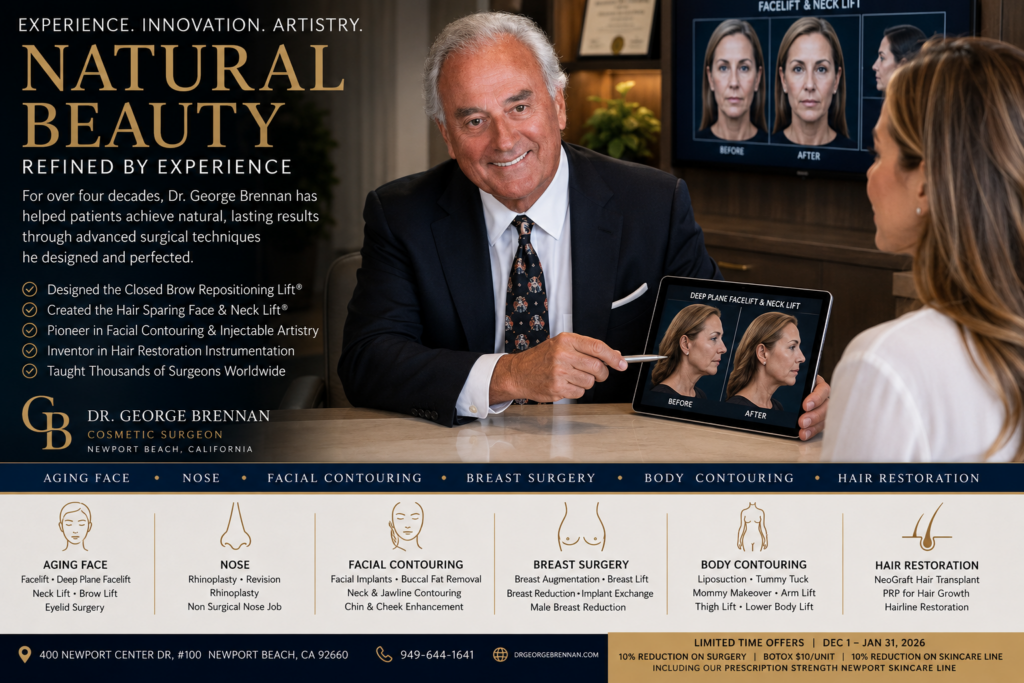
Dr. George Brennan has dedicated his career to advancing cosmetic surgery and developing techniques intended to produce balanced, natural-looking outcomes. His contributions include the Closed Brow Repositioning Lift, the Hair Sparing Face and Neck Lift, and multiple approaches to facial contouring and structural refinement.
These innovations reflect an important principle of modern facial rejuvenation: the goal should not be to change who a patient is. The goal should be to help that person look like a refreshed and naturally balanced version of themselves.
What Does Natural-Looking Facial Rejuvenation Mean?
Natural-looking facial rejuvenation does not mean making every patient look the same or following a standardized surgical template. Each person has a unique facial structure, skin quality, hairline, degree of tissue descent, and pattern of aging.
A successful rejuvenation plan respects these individual characteristics.
Natural facelift results typically aim to:
- Improve sagging along the cheeks and jawline
- Soften the appearance of jowls
- Restore a cleaner transition between the face and neck
- Reposition descended facial tissues
- Preserve natural facial movement and expression
- Avoid an excessively tight or windswept appearance
- Maintain the patient’s recognizable identity
An experienced surgeon understands that facial aging occurs in several layers. Skin changes are only one part of the process. Fat compartments may shift, facial support tissues can loosen, muscles may become more visible, and the jawline can lose definition.
Because these changes occur beneath the surface, simply pulling the skin tighter may not provide balanced or durable rejuvenation. Modern aging face surgery often involves repositioning deeper tissues while allowing the skin to settle without excessive tension.
Why Experience Matters in Facelift Surgery
A facelift is not a single technique that produces identical results for everyone. It is a highly customized procedure that requires careful decision-making before, during, and after surgery.
An experienced facelift surgeon evaluates how the entire face works together rather than focusing only on one wrinkle or isolated area of loose skin. This includes assessing the brow, eyelids, cheeks, jawline, chin, neck, and hairline.
Experience helps a surgeon determine:
- Which tissues need to be repositioned
- How much correction is appropriate
- Where incisions may be placed discreetly
- How to preserve the hairline and sideburn area
- Whether the neck should be treated with the face
- Whether volume loss or facial contouring should also be addressed
- How to avoid an overcorrected appearance
The American Academy of Facial Plastic and Reconstructive Surgery explains that facelift surgery may involve lifting the skin and repositioning underlying connective tissue. This deeper structural work is one reason surgical planning and technical experience are so important.
A surgeon must also understand when not to recommend surgery. Some patients may benefit from nonsurgical care, limited treatment, or a different procedure. Responsible recommendations should be based on anatomy, overall health, concerns, and realistic goals rather than a one-size-fits-all treatment trend.
The Difference Between Skin Tightening and Structural Rejuvenation
One of the biggest misconceptions about facelift surgery is that it is primarily a skin-tightening procedure.
Pulling the skin without properly supporting deeper tissues can contribute to visible tension, distorted features, noticeable scars, or results that do not age naturally. Structural rejuvenation takes a more comprehensive approach by addressing the tissues that have shifted over time.
Depending on the patient, a modern facelift may improve:
- Lower cheek descent
- Jowling along the jawline
- Loose tissue beneath the chin
- Neck bands
- Loss of jawline definition
- Deepened folds around the lower face
The skin is then repositioned smoothly over the restored facial framework. This can help produce a softer, more natural appearance.
Patients comparing options for a natural-looking facelift in Newport Beach should ask how a surgeon evaluates deeper facial aging, not only how much skin will be removed.
Dr. Brennan’s Hair Sparing Face and Neck Lift
Hairline preservation is an important but sometimes overlooked part of facelift planning. Incisions placed without careful consideration can alter the sideburn, disturb hair growth, or make it more difficult for a patient to wear certain hairstyles.
Dr. George Brennan designed the Hair Sparing Face and Neck Lift with a focus on rejuvenating the face and neck while avoiding unnecessary hair loss. This approach reflects his long-standing attention to the details that influence whether a surgical result appears discreet and natural.
The technique is especially relevant for patients concerned about:
- Preserving the natural hairline
- Avoiding visible changes near the temple or sideburn
- Maintaining flexibility with hairstyles
- Improving the lower face and neck together
- Achieving natural facial balance
Patients can learn more about Dr. Brennan’s procedural contributions on the practice’s cosmetic surgery innovations page.
A combined face and neck lift may be appropriate when aging is visible across both areas. Treating the face without addressing significant neck laxity can create an uneven transition. Likewise, treating only the neck may not fully correct jowls or descended cheek tissues.
For a closer comparison, read Neck Lift vs. Facelift: Which One Is Right for You?.
The Closed Brow Repositioning Lift
The position of the eyebrows can significantly influence whether the eyes appear rested, tired, open, or heavy. However, lifting the brows too aggressively may create an unnatural or surprised expression.
Dr. Brennan designed the Closed Brow Repositioning Lift to reposition the brow while avoiding the shocked appearance that can occur when the brow is elevated without respect for natural facial proportions. The technique was also developed with the goals of avoiding visible scarring and preserving the hair.
Brow rejuvenation may be considered when a patient has:
- Drooping or lowered brows
- Heaviness above the upper eyelids
- Facial asymmetry around the brow
- A tired appearance that is not corrected by treating the lower face
- Forehead and brow changes that disrupt overall facial balance
Not every facelift patient needs brow surgery. A detailed evaluation helps determine whether the brow, eyelids, lower face, neck, or a combination of areas should be addressed. This individualized planning is central to high-quality facial rejuvenation in Newport Beach.
Facial Contouring and the Importance of Proportion
Facelift surgery can reposition aging tissues, but facial balance may also be influenced by the shape of the cheeks, chin, jawline, and neck.
Dr. Brennan has developed multiple facial contouring techniques designed to reshape and refine the jaw, chin, and cheeks. Depending on the patient’s anatomy, contouring may involve carefully planned liposuction, volume adjustment, facial implants, or structural correction.
Facial contouring should not be used to chase a temporary trend. It should support the patient’s existing anatomy and create proportion between facial features.
For example, a patient with a recessed chin may still feel that the neck lacks definition after loose tissue is addressed. Another patient may have localized fullness that obscures the jawline. Recognizing these differences allows a Newport Beach cosmetic surgeon to develop a plan based on the whole face rather than treating one area in isolation.
Who May Be a Candidate for Facelift Surgery?
There is no single age at which everyone should consider a facelift. Candidacy depends more on anatomy, tissue laxity, health, and personal concerns than on a number.
Potential candidates may notice:
- Persistent jowls
- Loose skin along the lower face
- Reduced jawline definition
- Sagging in the cheeks
- Loose neck skin
- Vertical neck bands
- A tired appearance that does not reflect how they feel
- Limited improvement from nonsurgical treatments
Good candidates should also be in suitable health, understand the recovery process, and have realistic expectations. Smoking, certain health conditions, medications, and unstable weight may affect surgical planning or candidacy.
The American Board of Cosmetic Surgery facelift guide provides additional general information about facelift procedures, recovery, and choosing an appropriately trained cosmetic surgeon.
A personal consultation remains necessary because online information cannot account for individual anatomy or medical history.
Can Nonsurgical Treatments Replace a Facelift?
Injectables, skin resurfacing, peels, skin tightening, and other aesthetic treatments can improve certain concerns. They may be useful for maintaining skin quality, softening expression lines, replacing limited volume, or supporting patients who are not ready for surgery.
However, nonsurgical treatments do not reposition significantly descended facial tissues in the same way surgery can.
Using too much filler to compensate for sagging may add unwanted heaviness or distort natural facial proportions. An experienced surgeon knows when a nonsurgical approach is appropriate and when it may not adequately address structural aging.
Some patients may benefit from a staged plan that combines surgery with carefully selected nonsurgical maintenance. The goal should always be balanced treatment rather than performing every available procedure.
What Should Patients Ask During a Facelift Consultation?
A thoughtful consultation should provide education, not pressure. Patients should feel comfortable asking detailed questions about the surgeon’s background, recommendations, safety process, and expected recovery.
Helpful questions include:
- What areas of my face are contributing most to my concerns?
- Would I benefit from a facelift, neck lift, brow procedure, or combination?
- How will my hairline and sideburns be protected?
- How do you avoid an overly tight appearance?
- Where will the incisions be placed?
- What are the risks and limitations?
- What should I expect during recovery?
- Can I review relevant before-and-after photographs?
- How will my treatment plan be customized?
- What can I do to support safe healing?
Patients should also discuss all medications, supplements, nicotine use, previous procedures, and medical conditions.
The Aesthetic Society’s patient safety resources emphasize the importance of overall health, honest medical disclosure, and understanding the precautions needed to reduce surgical risk.
What Is Facelift Recovery Like?
Recovery varies according to the surgical plan, the areas treated, and the patient’s individual healing response.
Swelling, bruising, tightness, temporary numbness, and mild asymmetry can occur during early healing. These effects generally improve gradually, but the final result should not be judged immediately after surgery.
Many patients plan for approximately two weeks away from public-facing responsibilities, although some need more or less time. Strenuous exercise and heavy lifting typically require a longer pause based on the surgeon’s instructions.
Patients should carefully follow guidance regarding:
- Incision care
- Sleeping position
- Activity limitations
- Medication use
- Follow-up appointments
- Sun protection
- Signs that require medical attention
Facelift surgery does not stop the aging process. Instead, it repositions tissues from their current aged position. The face will continue to age naturally, but patients may continue to appear more refreshed than they would have without surgery.
Choosing a Facelift Surgeon in Newport Beach, California
Patients looking for a facelift surgeon in California may encounter many procedure names, marketing claims, and trending techniques. Terms such as mini facelift, SMAS facelift, deep plane facelift, vertical lift, and extended facelift can make the process confusing.
The name of the technique matters less than whether the surgeon selects and performs the right approach for the patient.
When researching a facelift in Newport Beach look for:
- Relevant surgical training and certifications
- Extensive experience with facial procedures
- Natural-looking before-and-after results
- Transparent discussions about risks and recovery
- A personalized consultation process
- Attention to hairline and incision placement
- A clear understanding of facial symmetry and balance
- An accredited or appropriately equipped surgical setting
- Consistent postoperative support
Dr. George Brennan’s career has included extensive facial surgery experience, the development of surgical techniques, and the education of physicians in cosmetic surgery. His work reflects a detailed approach to facial structure, hair preservation, and natural aesthetic planning.
Explore additional patient education through the practice’s cosmetic surgery learning center.
Frequently Asked Questions About Natural Facelift Results
Will a facelift make my face look tight?
A carefully planned facelift should reposition descended tissues without creating excessive skin tension. The goal is usually to help the patient look refreshed rather than noticeably operated on.
Does a facelift treat the brow and eyelids?
A standard facelift primarily addresses the lower face and jawline. Brow or eyelid procedures may be considered separately when those areas contribute to facial aging.
Should the face and neck be treated together?
They are often treated together when aging affects both areas. A combined approach can create a smoother transition between the cheeks, jawline, chin, and neck.
How long do facelift results last?
Results vary based on technique, anatomy, skin quality, lifestyle, weight changes, and the natural aging process. Surgery can provide meaningful long-term improvement, but it cannot permanently stop aging.
What makes a facelift look natural?
Natural facelift results depend on appropriate patient selection, structural support, controlled skin tension, discreet incision placement, preserved hairlines, facial balance, and experienced surgical judgment.
A Personalized Approach to Facial Rejuvenation
The most effective facial rejuvenation plan is not necessarily the most extensive one. It is the plan that addresses the patient’s actual anatomy while protecting natural expression, proportion, and identity.
Dr. George Brennan’s approach incorporates surgical experience, innovation, and an understanding of how facial structures age together. His Hair Sparing Face and Neck Lift, Closed Brow Repositioning Lift, and Facial Contouring techniques were developed to address important details that can influence both appearance and patient confidence.
Patients considering a natural-looking facelift in Newport Beach can begin with an educational consultation to discuss their concerns, candidacy, options, recovery, and realistic expectations.
To learn more about facial rejuvenation or request a private consultation with Dr. George Brennan, visit the Dr. George Brennan Cosmetic Surgery website.